Most support leaders begin to wonder what is call deflection after a call queue becomes a breaking point. This increases the number of calls to the service desk, customers have to wait to get their issues resolved, and adding more agents becomes unsustainable. Call deflection is when a customer issue is solved using self-service, chat, or an AI agent before it becomes a live phone call. By introducing digital support options, you can expect to reduce call volume and operating expenses by 25 to 30%. This blog explains what is call deflection, its working rate formula, and the difference between call deflection vs containment rate and call deflection vs first call resolution.
What Is Call Deflection?
Call deflection is about getting a customer off the phone and onto the channel that can resolve their issue, just as effectively, if not more quickly. Consider IVR menus that respond to a billing question, a chatbot that guides a person through a password reset procedure, or a help center article that addresses a shipping inquiry before anyone calls the help number.
The question of why you’re asking what is call deflection is to cut back on calls coming to your contact center. It’s to get rid of the need to even make a phone call. If a customer gets to not understand the chatbot and then calls, they were delayed, but they weren’t deflected, and they may be more frustrated than they would have been if they had called from the beginning.
That distinction matters. Real call deflection, however, solves the problem. It doesn’t simply shift it to another location and prohibit the client from returning.
Why Businesses Keep Asking What Is Call Deflection
Support teams researching what is call deflection often find themselves comparing vendor definitions that don’t quite agree. Some treat it as any interaction that avoids a live agent, deflected or not. A more useful way to define what is call deflection, and the definition this blog uses throughout, is one grounded in actual resolution: the customer got their answer, and they didn’t need to pick up the phone to get it.
How Does Call Deflection Work?
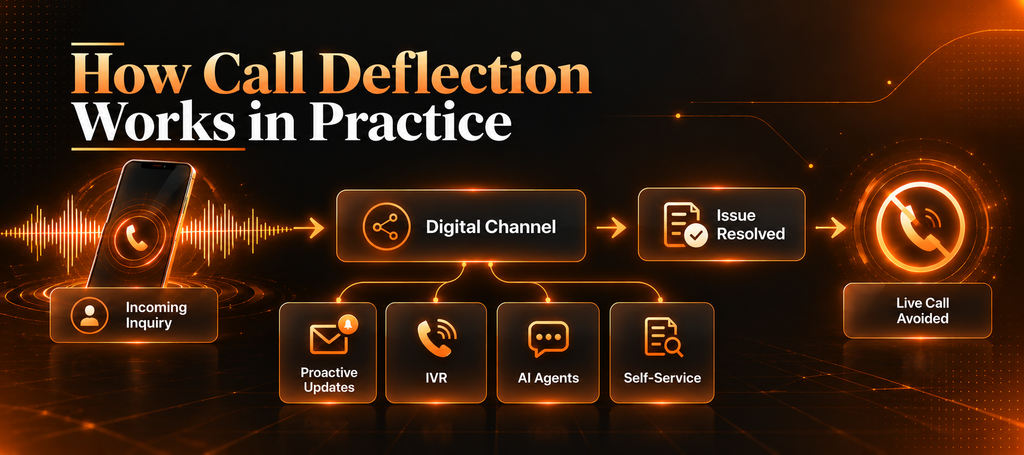
Call deflection typically happens at one of a few touch points in the customer journey.
Before the Call Starts
Proactive SMS or email updates, such as shipping delays or billing changes, answer the question before the customer ever feels the need to dial in. This early stage of call deflection is often the cheapest to build and the most overlooked, yet it answers what is call deflection, at its simplest is preventing the call before it starts.
At the IVR Stage
Basic, frequent customer requests such as checking the balance, store hours, or order status can be processed via interactive voice response systems without the need for a live agent.
Through Chat and AI Agents
AI-powered chatbots and voice AI agents handle repetitive customer queries on the fly, drawing on a knowledge base or CRM for correct answers in real time.
Via Self-Service Portals
FAQ pages, community forums, and help center articles allow customers to troubleshoot on their own time and at their own pace. Understanding what is call deflection really means – it’s not one tool or channel. It’s a method that links a number of channels collectively so customers reach wherever they can get resolved quickest. Any team building a roadmap based on call deflection should structure these touch points with key contact reasons in mind before deciding on the first channel to invest in.
What Is the Call Deflection Rate Formula?
You can’t manage what you don’t measure, and that’s exactly why the call deflection rate formula matters so much to support teams. The standard call deflection rate formula looks like this:
Call Deflection Rate (%) = (Self-Service or Digital Resolutions ÷ Total Customer Inquiries) × 100
Here’s a quick example using the call deflection rate formula: if your contact center receives 10,000 total inquiries in a month and 3,500 of those are fully resolved through self-service, chat, or an AI agent, your call deflection rate is 35%.
What Counts as a Healthy Call Deflection Rate
Once a team has a working answer to what is call deflection worth in dollar terms, benchmarking becomes far more useful, and that answer shifts by industry. A healthy call deflection rate typically sits above 30 to 40%, though this varies heavily by industry and query type. Password resets and order status checks tend to deflect at much higher rates than billing disputes or complex technical issues, simply because the former are repetitive and well suited to automation. It’s worth noting that the call deflection rate formula only tells you how many contacts were diverted, not whether those customers were actually helped.
Call Deflection vs Containment Rate: What’s the Difference?
Definitions Side by Side
This is one of the most confused pairs of metrics in customer support, so it’s worth untangling call deflection vs containment rate clearly before deciding what is call deflection should be judged on.
- Call deflection rate measures how many potential calls were redirected to another channel, regardless of what happened next.
- Containment rate measures how many of those deflected interactions were resolved without escalating back to a live agent.
Why the Distinction Matters
Here’s why the call deflection vs containment rate distinction matters: a business can have an impressively high deflection rate while quietly frustrating customers who couldn’t get their issue solved through self-service and had to call back anyway. When you look at call deflection vs containment rate side by side, containment is the metric that tells you whether your self-service actually works, while deflection only tells you it exists. Don’t celebrate a rising call deflection rate until you’ve checked what your containment rate says about it.
Call Deflection vs First Call Resolution: How Are They Different?
What First Call Resolution Measures
Another comparison worth understanding is call deflection vs first call resolution, or FCR, because the two sound related but measure very different things and answer a different version of what is call deflection meant to do. First call resolution tracks whether a customer’s issue is fully resolved during their very first contact with support, whether that contact happens over the phone, chat, or email. Call deflection, on the other hand, measures whether a contact was prevented from becoming a live call in the first place.
How the Two Metrics Work Together
A call deflection vs first call resolution comparison: deflection happens before the agent gets involved in the call, and FCR after they are already interacting with the agent, be it human or AI. Deflecting calls and FCR need to be tracked together in a well-designed support operation, since a good deflection strategy that sends unresolved cases to agents will have a negative impact on FCR in the end.
Why Does Call Deflection Rate Matter for Businesses?
Cost and Efficiency Gains
A strong call deflection rate isn’t just an internal efficiency metric; it has a direct impact on cost, customer experience, and agent well being, which is exactly why leadership teams want a straight answer to what is call deflection worth. Digital resolutions typically cost a fraction of what a live phone call costs to handle, and businesses can handle rising inquiry volume without proportionally growing headcount.
Customer Experience and Agent well being
Customers receive immediate answers, no longer having to wait on hold, and fewer repeat calls allow agents to concentrate on more complicated, higher-value calls. None of these come as a right, however. They only appear when there is actual problem-solving, not call avoidance, that’s happening in the underlying call deflection rate.
That’s why finance and operations teams, alongside support leaders, have begun to ask what is call deflection and how it relates to overall cost-to-serve. A small bump in call deflection rate can make a huge difference when multiplied by the volume of contacts, when digital resolutions are just a small percentage of a live call.
What Are the Best Channels for Call Deflection?
Not every channel deflects every type of query equally well.
IVR Systems
Best for simple, transactional requests like account balances or appointment confirmations, and often the first place businesses look when they ask what is call deflection can handle without any AI involved.
AI Agents and Chatbots
Best for a broad range of routine queries, especially when they can pull real-time data from a CRM or order management system.
Knowledge Bases and FAQs
Best for how-to questions and troubleshooting that customers are comfortable solving independently.
SMS and Proactive Notifications
Best for preventing calls before they happen, such as delivery updates or billing alerts.
Community Forums
Best for niche or product-specific questions where peer answers add credibility.
The most effective setups combine several channels, with context carrying over so customers never have to repeat themselves. Choosing the right mix ultimately comes back to what is call deflection meant to accomplish for your specific customer base.
What Are the Common Mistakes in Call Deflection?
Plenty of businesses attempt call deflection and see their metrics improve without their customer experience improving at all.
Deflecting Without a Destination
Telling customers to check the website only works if the website actually answers their question, a mistake that comes from skipping the basic homework on what is call deflection meant to solve.
Treating Callbacks as Deflection
A callback removes someone from the queue temporarily, but an agent still has to make that call eventually.
Ignoring Re-Contact Rates
If deflected customers keep calling back for the same issue, deflection isn’t working; it’s just adding a delay.
Deploying AI Without Context
The frustrating thing is that when a chatbot doesn’t have access to order history or previous customer interactions, it will end up with a lot of unhappy customers, and when you push sensitive or complex topics, such as billing disputes, to chatbots, it’s a lose-lose situation.
The cause of most of these errors is the same: They roll out a tool without first understanding what the purpose of deflection was to solve for their customers.
How Can Businesses Improve Their Call Deflection Rate?
Short-Term Fixes
Analyze call intent first to identify the handful of reasons driving most inbound volume, since this is the single biggest factor in getting a useful answer to what is call deflection worth pursuing first. Keep self-service content current, too, since outdated help articles are one of the fastest ways to sabotage an otherwise solid call deflection rate.
Long-Term Strategy
Give AI agents real context by connecting them to CRM and order data, track containment and CSAT alongside call deflection rate to confirm customers are satisfied, and reserve live agents for issues that genuinely require judgment, empathy, or negotiation.
What Does the Future of Call Deflection Look Like?
The Role of AI Agents
The next level of call deflection is being defined almost exclusively by AI agents that can speak to customers instead of just deflecting them. Traditional IVR systems deflect by providing options on a menu, while basic chatbots deflect by looking for keywords and finding answers in the script. Modern AI agents can go beyond: understand intent, fetch real-time account/order data and even solve issues end-to-end (voice, chat, messaging).
What Is Call Deflection Becoming?
This shift is changing how businesses should think about what is call deflection altogether. It’s no longer just a routing decision made when a call comes in. It’s becoming a continuous capability that gets smarter with every interaction, feeding data back into self-service content, agent scripts, and future automation.
Who Should Care About What Is Call Deflection?
Product and Marketing Teams
Product teams benefit because deflection data highlights confusing features or unclear billing logic that drive repeat calls, another angle on what is call deflection reveals. Marketing teams benefit too, since self-service pages built to deflect calls often double as SEO assets.
Leadership and Finance Teams
Leadership benefits because a clear view of what is call deflection translates directly into a cost-to-serve number that’s easy to defend in a budget conversation. Put simply, what is call deflection stops being a niche contact center term the moment a business realizes how many departments touch the customer journeys it’s designed to shorten.
Conclusion
The real issue of “call deflection” is no longer about automation, but about “what people are trying to do” with it. It’s all about knowing where digital channels really add value to the customer and where they’re not. When done properly, it reduces expenses, enhances resolution times, and enables agents’ availability for interactions that require human contact. If it’s not done well, it simply moves frustration around rather than takes it away. The companies doing it right are not just monitoring their call deflection rates; they’re monitoring their call deflection rates in conjunction with containment rate and first call resolution to ensure customers are being assisted. Call deflection will continue to evolve from a routing strategy to a true problem-solving capability embedded in the typical support operation as AI agents develop.
Frequently Asked Questions
Here are quick, SERP-ready answers to the questions people ask most alongside what is call deflection.
What is call deflection in customer service?
Call deflection redirects customers from phone calls to self-service, chat, or AI channels to resolve issues faster, without needing a live agent for every routine question.
What is a good call deflection rate?
Most industries consider 30 to 40% a solid baseline, though mature AI-driven support operations often deflect well above 50% on routine, repetitive queries.
Is call deflection the same as call avoidance?
No. Genuine call deflection resolves the customer’s issue through another channel, which is the core of what is call deflection. Call avoidance just blocks access to an agent without actually solving anything.
Does call deflection hurt customer experience?
Not when done well. Poorly designed deflection frustrates customers, but well-targeted deflection backed by accurate self-service content often improves satisfaction and speed.