What is endpointing? The task a voice AI system performs to determine when a speaker has finished speaking so it can stop listening and start responding. It’s a combination of voice activity detection, silence timing, and now, more than ever, the context of words. Make the right decision, and a conversation comes across as natural. If you get it wrong, the agent will break the flow of the conversation, or there will be awkward dead air. Learn how endpointing works in voice AI, how a speech endpointing algorithm performs a call, why endpointing latency is important, and the difference between endpointing and turn detection to create or analyze voice agents that respond when it is appropriate.
What Is Endpointing in Voice AI and Why Does It Matter?
Have you ever been cut off mid-thought by a voice assistant? Their vocabulary was good, and their speech recognition was good. The timing simply wasn’t right, and that’s what endpointing voice AI systems are designed to handle. After all, what is endpointing but the art of knowing when someone’s done?
What Is Endpointing: The Plain-English Definition
It’s the split-second judgment that a speaker’s turn is over. The words may already be transcribed correctly, but the system still has to guess whether you’re finished or just catching your breath. That makes endpointing a timing decision, not a transcription one.
What Is Endpointing Not: Clearing Up the Confusion
It isn’t speech recognition, which turns audio into text. It isn’t voice activity detection either, which only labels audio as speech or silence. Endpointing builds on both to make a higher-level call about whether a whole turn is finished.
What Is Endpointing Worth: The Business Case for Better Turn-Taking
This is something that people do easily. In normal conversational speech, the length of silence between speakers is about 200 milliseconds, which is half a second. Typically, a gap of half a second (200 milliseconds) of silence exists between the end of one turn and the start of the next in natural conversation, as people predict when the turn will end rather than wait for a pause. Yet machines can’t predict that, so they listen, measure, and decide. So the stakes are increasing: conversational AI will save contact center agents $80 billion by 2026, and that figure is only realized when customers can interact with a voice agent without wanting to hang up.
How Does Endpointing Voice AI Technology Shape the User Experience?
Every voice agent sits between two failure modes. So what is endpointing really optimizing? Not speed alone and not caution alone, but the best trade-off between the two at every moment of a conversation.
Failure Mode One: Cutting In Too Early
A caller says, “I’d like to book a flight to…” and pauses to check a calendar. The agent jumps in with a question, and the caller must start over.
Failure Mode Two: Waiting Too Long
The agent remains silent and is cautious. It can seem as if the phone line dropped in a phone call after only 400 milliseconds. Wait is the endpoint of latency.
What Is Endpointing Fighting: Natural Human Pauses
A pause in the search for a word can last between 600-900 milliseconds and is likely to be longer if the speaker thinks aloud, is an older speaker, or is not a native speaker. A threshold set by the speed and confidence of talkers promotes the exact people who it should exclude.
How Does a Speech Endpointing Algorithm Work?
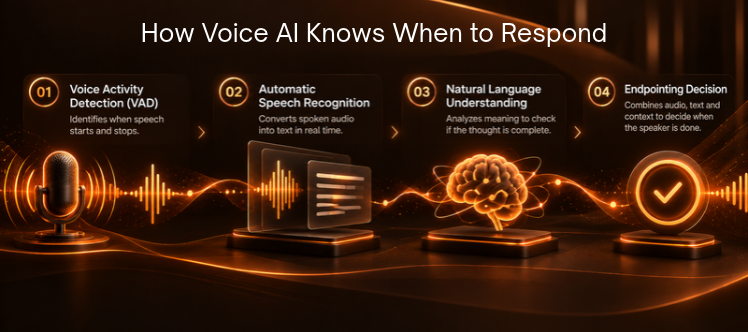
A modern speech endpointing algorithm is not anything one size fits all. It is a collection of decisions; each is dependent on the other, and each one addresses a different question.
Layer 1: Voice Activity Detection
VAD splits audio into frames of roughly 20 to 30 milliseconds and labels each as speech or non-speech. Older versions measure signal energy, while newer ones like Silero VAD use small neural networks that handle noise better. A short hangover window, often around 200 milliseconds, stops tiny gaps between words from counting as silence.
Layer 2: The Silence Timer
Once speech stops, the system waits a set number of milliseconds and then declares the turn over. It’s simple, so it remains a default in many stacks. It’s also blunt: half a second of quiet means something different after “Yes.” than after “I was calling because.”
Layer 3: Transcript Signals
Streaming speech-to-text delivers interim results which continue to change and later final results. A final transcript is usually towards the end of a speech, but the recognizer completes itself based on its own logic, not on whether the speaker completed their sentence. Don’t assume that it is a fact; it is an input.
Layer 4: Semantic Understanding
The newest layer asks whether what’s been said sounds complete. “My account number is four, seven, two…” is clearly unfinished, even after a long pause. “That’s all, thanks” is clearly done, even after a short one. Ask what endpointing is doing here, and the answer is judging meaning, not just sound.
How the Layers Combine
In production, semantic models blend audio cues with the meaning of the text, so the agent can answer fast after a finished thought and wait after an open one. The silence timer becomes a fallback rather than the whole decision.
What Is Endpointing Latency and How Much Is Too Much?
In the world of endpointing, it’s in the “Latency”. To tune it, you have to understand what endpointing latency is in the first place, and why it’s so hard to measure.
The Hidden Delay
The addition of the time delay from the end of the speaker’s turn to the turn-over declaration by the system is called endpointing latency. It’s embedded in Total Response Time and tends to get overlooked by teams.
How Latency Stacks With Other Delays
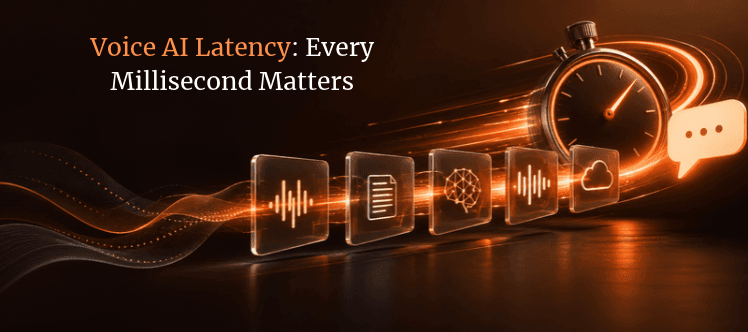
Endpointing latency is added to the delay caused by speech recognition, language model, and speech synthesis. If it’s recognized immediately, but the endpointer waits 800 milliseconds before he/she is certain, the caller feels an 800-millisecond delay; he/she is waiting until the agent thinks. A shorter timeout (200 milliseconds) can do more to increase the perceived speed than a faster model.
Metrics Worth Tracking
When teams ask what is endpointing latency in numbers, the answer should be percentiles, not averages:
- p50: the typical gap after a caller finishes.
- p95: what one caller in twenty experiences.
- p99: your worst regular moments. An average of 400 milliseconds looks healthy, but a p99 of 2.5 seconds means one caller in a hundred thinks the call broke.
Pair these with interruption rate, meaning how often the agent cuts someone off, so you never improve speed at the expense of politeness.
Endpointing vs. Turn Detection: What Is the Difference?
The two terms get swapped constantly, even in vendor documentation. They’re related, but they aren’t the same thing. So what is endpointing responsible for, and what falls to turn detection?
Endpointing vs. Turn Detection at a Glance
| Endpointing | Turn detection | |
| Core question | Has the speaker finished, or just paused? | Whose turn is it right now? |
| Scope | One decision: when to finalize and respond | The full flow, including interruptions |
| Typical inputs | VAD output, silence timing, transcript, semantic cues | Endpointing result, barge-in signals, agent speech state |
| When it fails | Cut-offs or dead air | Talk-over, missed interruptions, stalled turns |
Turn Detection in Voice AI Explained
Put simply, turn detection in voice AI is the entire dance, and endpointing is the cue that says it’s time to step in. Turn detection also covers barge-in, where a caller interrupts mid-sentence, and the system must stop talking, listen, and avoid mistaking its own playback echo for the caller’s voice.
Where Voice Activity Detection Fits
VAD sits upstream of both. So what is endpointing job in the stack? It’s the decision layer between raw audio and conversation management.
What Is Endpointing Up Against on Real-World Calls?
Demos are clean and live calls aren’t, and endpointing voice AI systems feel that gap first. If you want to know what endpointing toughest test is, look at these everyday situations.
Fillers and Backchannels
A trailing “um” keeps a silence-based detector waiting, while a listener’s “mm-hm” can register as speech and reset the timer.
Telephony Audio and Noise
Phone calls are sampled at 8 kHz and limited to roughly 300 to 3400 Hz, which blurs the line between quiet speech and silence. Line noise and carrier comfort noise push detectors toward false readings.
Echo and Barge-In
Without echo handling, the agent’s own audio leaks into the microphone and confuses turn logic. Reading out an account number adds natural gaps that look like endings. None of this appears in a quiet test room, which is why endpointing that looks perfect in a demo can fall apart on a live line.
What Is Endpointing Tuning, and How Can You Test It?
Good endpointing isn’t set once and forgotten. Here’s how teams keep their speech endpointing algorithm and its endpointing latency in shape over time.
Tune for Each Use Case
Ask what is endpointing doing for a patient intake line versus a drive-through ordering bot, and the answers differ. Older callers need a slower rhythm, while fast ordering needs snappy turns, so keep wait times configurable and use separate thresholds for phone audio.
Test the Hard Cases on Purpose
Record the script with pauses, filler words, noises, and interruptions in the middle of the sentences and repeat the recording after any edits. A shorter timeout might lead to an increase in interruptions from slow speakers, only to be discovered by the callers when they repeat the test.
Choosing a Starting Timeout
The question that is frequently asked about endpointing is what is the best default setting? There isn’t one. Typical starting points, and not destinations, are fixed timeouts of a few hundred milliseconds to around a second. Some teams also form a reply from a stable, non-finalized text in the meantime, which is then retrieved in a few milliseconds without waiting for the last packet.
What Does the Future of Turn Detection in Voice AI Look Like?
So what is endpointing becoming? The field is moving from stopwatches to models, and turn detection in voice AI is leading the shift.
From Fixed Timers to Learned Models
LiveKit ships a turn-detector model, Pipecat offers an open smart-turn model, and providers such as Deepgram and Krisp offer end-of-turn detection beyond silence. Some read the words, others predict from audio alone, but all replace a fixed timer with a judgment. Transformer-based work like TurnGPT showed that language models can anticipate where a turn is likely to end.
Trade-Offs That Remain
Semantic detection isn’t free. It needs more compute and can still stumble on turns a human would find ambiguous. So what is endpointing gaining from all this? The hard call moves from a number you guess to a judgment the system can make, and latency becomes a tunable budget.
What Is Endpointing Really About? The Takeaway
So, what exactly is endpointing, at its heart? It’s the turn that signals a voice agent when to end the conversation – it makes the difference between a natural or frustrating conversation. The best systems don’t just work by themselves. They add layers of voice activity detection, timing, transcript signals, and semantic understanding, and tune them for each listener and channel. Ensure that endpointing latency is not an issue and measure it using percentiles – test the “messy cases” before the real callers do. Knowing endpointing vs. turn detection makes debugging quicker, and a good speech endpointing algorithm raises all other components of a voice stack. Once the time is right, the rest of the conversation flows.
Frequently Asked Questions
What is endpointing?
Endpointing is how a voice AI system decides a speaker has finished their turn. It combines voice activity detection, silence timing, and sometimes word meaning to know when to respond.
How does endpointing work in voice AI?
It starts with voice activity detection spotting speech and silence. Then a silence timer, transcript signals, and semantic checks decide whether the speaker is truly finished or just pausing briefly.
What is the difference between endpointing and turn detection?
Endpointing is the single decision that a speaker has finished. Turn detection is the broader system managing whose turn it is, including responses, interruptions, and barge-in handling during live calls.
What is endpointing latency, and what is a good value?
Endpointing latency is the delay between a speaker finishing and the system responding. No single value fits; a few hundred milliseconds to one second is common; semantic models adapt it.