What is turn detection? It’s technology that enables the voice AI agent to detect when a person has begun speaking, when they have finished speaking, and when it is appropriate for the voice AI agent to respond. Voice AI-powered detection of those moments combines voice activity detection (VAD), automatic speech recognition (ASR), and natural language understanding (NLU). That’s why one agent seems to be talking to you and the other seems to be talking in a telephone menu. If it’s right, the talk sounds natural. If the agent gets it wrong, he cuts in on the speaker, and there is silence. Here you will find information about what turn detection is, the major techniques used for detecting turns, when they are not working, and how to select the right setup to sustain in production.
Why Does Turn Detection Matter More Than Most Teams Expect?
Most teams focus on the language model, but a good response at the wrong time is still a bad response, and so “what is turn detection” is a good question to answer correctly. It’s all about the timing when it comes to a call sounding human.
The Business Case for Natural Conversations
Things are getting more competitive. By 2028, 30% of Fortune 500 companies will be using only a single AI-powered channel for their services, and voice-powered conversational AI will be a key contributor to that, says Gartner. With voice as the front door, awkward turn-taking turns into a business dilemma, and turn detection in voice AI is a customer journey. That renders the question of what is turn detection a boardroom question, rather than an engineering one.
The Cost of Poor Timing
Weak turn detection in AI shows up in four ways:
- Interruptions: Agent speaks over customers who still have thoughts in their minds.
- Dead air: A customer believes that the line has dropped and hangs up.
- Lost context: Incomplete sentences are half-captured, and sometimes answer the wrong question.
- Wasted compute: Agent responds to a cough, a TV, or an off-topic conversation.
What Is Turn Detection in AI Conversations, Exactly?
Let’s stick with an easy answer. The basic answer to the question “what is turn detection” is turn-taking in the context of machines. In humans, it is controlled by reading pitch, rhythm, grammar, and breath. No face to “read” a voice agent, and therefore, it works from audio and text only — in a split second.
What Is Turn Detection: A Plain-Language Definition
Turn detection in AI is the system that keeps asking one question: has the speaker finished, or are they just pausing? Anyone searching for what is turn detection should remember that it’s a decision, not a sensor.
Start-of-Turn and End-of-Turn Events
So what is turn detection handling? Two events, and everything else in the voice stack depends on them:
- Start of turn: the user begins speaking, so the agent should listen and, if needed, stop talking.
- End of turn: the user is done, so the agent can respond.
Why Turn Detection Is Not Just a Silence Timer
Understanding what is turn detection means seeing why timers alone fail. It also isn’t the same thing as VAD. Picture a caller saying, “I’d like to book a table for four on Friday…” and then going quiet. Finished, or still working out the time? The words are identical either way; only tone and what comes next can tell you.
How Does Turn Detection Work in Voice AI?
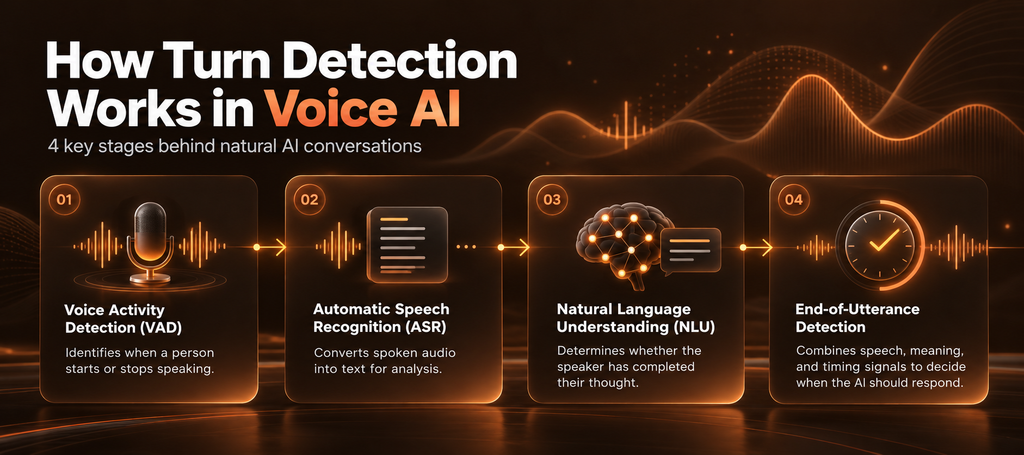
Once you know what is turn detection at a basic level is, the next step is seeing the layers behind it. Turn detection that voice AI agents can trust comes from stacking signals, because no single one is enough.
Voice Activity Detection (VAD) as the First Gate
If you map “what is turn detection” onto a pipeline, VAD is layer one. It is a lightweight model that labels each slice of audio as speech or non-speech. It’s fast, cheap, and gives raw start and stop signals. What it can’t do is understand meaning, since a thinking pause and a finished sentence both look like silence. Many teams pair VAD with a volume check, so loud beeps and faint background voices don’t count.
Automatic Speech Recognition as the Text Layer
In the “what is turn detection” pipeline, ASR supplies the words. Automatic speech recognition (ASR) turns audio into streaming text. Many engines also flag when a transcript looks final, which gives you a basic endpoint. If your turn-taking is tied to one automatic speech recognition vendor, switching vendors changes how your agent feels in conversation.
Natural Language Understanding for Completeness
This is where “what is turn detection” becomes a question about meaning, not just sound. Natural language understanding (NLU) checks whether the words form a complete thought. “I’d like to cancel my” is clearly unfinished. “I’d like to cancel my order” probably isn’t. Text alone has limits, though, because identical words can end a thought or lead into more speech.
End-of-Utterance Detection: Making the Final Call
End-of-utterance detection is the decision itself: the moment the system commits to “this person is done.” It merges silence length, automatic speech recognition output, NLU of the transcript, and acoustic cues such as falling pitch into a single call. Make end-of-utterance detection too eager, and the agent interrupts. Make it too patient, and you get dead air.
What Are the Main Approaches to Turn Detection?
When people ask what is turn detection, they often assume it’s one technique. It’s really a ladder of four, each smarter than the last, and each suited to different jobs for turn detection voice AI agents rely on.
Four Approaches Compared
| Approach | How it decides | Strength | Weakness |
| Fixed silence timer (VAD only) | Waits a set window of silence | Simple and fast | Cuts in on pauses or lags behind |
| ASR endpointing | Transcript is marked final by the speech engine | Language-aware | Quality varies, vendor lock-in |
| Semantic model | Reads the text for completeness | Understands meaning | Can’t hear tone |
| Audio-based model | Analyzes how speech sounds plus what it means | Catches pitch and rhythm | Heavier to run and tune |
How Pipecat, LiveKit and Deepgram Handle It
Pipecat’s Smart Turn pairs VAD with a model that judges whether an utterance is complete. LiveKit offers a turn detector that fuses semantic and acoustic signals. Deepgram builds turn signals directly into its Flux speech recognition engine.
Choosing the Right Approach
Simple timers are fine for short, predictable prompts like “press one for sales.” For open conversation, move to a model-based setup that blends NLU with acoustic cues. The best answer to what is turn detection for open conversation is a layered one.
How Does Barge-In Detection in Voice AI Work?
Turn detection isn’t only about when the agent starts talking. It’s also about when the agent should stop. That’s barge-in detection in voice AI: spotting that the user is speaking over the agent and deciding how to react. Anyone who wants to understand what is turn detection in full needs both directions.
Interruptions, back channels and False Triggers
Three things can happen mid-response:
- A real interruption (“Wait, cancel that”): stop and listen.
- A back channel (“mm-hmm,” “right”): keep talking.
- A false trigger (a cough, background chatter): ignore it.
Basic systems treat any speech as an interruption. Smarter barge-in detection classifies the sound before reacting.
Supporting Techniques for Smooth Barge-In
- per-buffering: a rolling slice of recent audio, so the first words are never lost.
- Playback tracking: timestamps matched to the agent’s text, so it knows what the user already heard and doesn’t repeat itself.
- Protected phrases: some legal disclosures must finish, so interruptions can be paused or made stricter for those lines.
Think of barge-in as the other half of the “what is turn detection” puzzle.
Why Is Turn Detection So Hard in Real Conditions?
Demos are easy. Real calls aren’t. The honest answer to what is turn detection in practice is that it’s a moving target, shaped by noise, speakers, and speed.
Noise and Overlapping Voices
Traffic, machinery, and open offices all create false triggers. Cleaning the audio before VAD runs, and requiring volume and speech probability to agree, keeps the agent from reacting to beeps and background chatter.
Pauses, Fillers and Code-Switching
People slow down when they recall numbers, names, or addresses. Fillers like “um” look like speech but often mean “I’m not done.” Speakers who switch languages pause differently too, so models tuned on one pattern misfire. Strong end-of-utterance detection has to tolerate all of this.
The Latency Trade-Off
Waiting longer feels slow, while shortcuts cause interruptions. Ask “what is turn detection” in a quiet lab, and you get one answer. Ask it on a noisy call, and you get another. A patient support line needs more breathing room than a fast order-taking bot.
What Is Turn Detection Used For Across Industries?
Anywhere a voice agent talks to real people, timing matters, which is why the answer to what is turn detection always depends on the caller and the context.
Healthcare and Banking
In healthcare, “what is turn detection” matters because callers pause to recall dates and medications during booking and reminders. In banking and finance, account queries and collections calls include disclosures that must be heard in full.
Retail and Telecom
Retail and e-commerce agents handle order status and returns, often from noisy homes and busy streets. In telecom, “what is turn detection” is really a scale question: support lines run at high volume, so a few seconds of dead air multiplies across thousands of calls.
How Can You Test Turn Detection Before Launch?
Teams that understand what is turn detection in their own stack test it on purpose, with both scripted checks and real audio.
The Five-Check Test
Run these checks on any turn detection voice AI agents use before going live:
- The thinking pause: say a long sentence with a mid-sentence pause. Does the agent jump in?
- The interruption: cut in with “actually, wait.” Does it stop quickly?
- The back channel: say “mm-hmm” while it talks. Does it carry on?
- The noise test: cough or clap near the mic. Does it restart for no reason?
- The accent test: try different accents and mixed-language sentences. Do pauses trigger false endings?
Replay Testing With Real Calls
Detection voice AI agents should be replayed on real recordings after each change – a change that resolves an issue may be the source of a new one and so on. Separate false cutoff detection, long gaps for end-of-utterance detection, and barge-in detection in voice AI.
Which Best Practices Keep Turn Detection Reliable in Production?
Understanding what “turn detection” is is the first step. Maintaining it reliably is its ongoing job, and layered signals beat clever tricks.
Signal and Threshold Practices
- Clean the audio first: noise suppression before voice activity detection (VAD) steadies everything downstream.
- Combine signals: require VAD and volume to agree before counting a frame as speech.
- Use time gates and hysteresis: ask for sustained speech before starting a turn, and use a lower bar to stay in it, so the system doesn’t flicker.
- Tune per use case: healthcare, banking, and retail callers behave differently.
Ongoing Monitoring and Iteration
Detection of turn in AI is always a “try it and see” process. Record false cuts and long breaks, and make adjustments. Teams that consider turn detection as a living system in voice AI ensure agents sound natural. Make sure to review your own agents’ “what is turn detection?” periodically, and not just once.
What Comes Next for Turn Detection in Voice AI?
The definition of what turn detection is will continue to change. Enhancing the signals and integrating them more closely will be the next advances in turn detection for AI, not faster models.
Richer Signals and Intent Modeling
Separation of real interruptions from small talk can be performed by using pitch contours, prosody, and overlap detection. A “yeah” can be distinguished from a “hold on” by better intent modelling.
Per-User Adaptation and Model Integration
Agents can get an idea of the caller’s voice rate and volume during a session, and native speech models can close the time lag between listening and responding.
So, What Should You Do Next?
Once you have a grasp of what is turn detection and why it is important, it is time to start using it! Turn detection appears very simple on the surface, yet is very significant in practice. It shapes the experience of your voice agent from a friendly co-worker to a time-constrained robot. The best setups include all the layers of clean sound, VAD, speech recognition, language understanding, and acoustic cues, and then fine-tune all of them against actual calls. At Analytics.ai, our dedicated team of AI experts specializes in creating, developing, and optimizing conversational AI solutions, including NLP, generative AI, to production-ready voice agents.
What Do People Ask Most About Turn Detection?
Here are quick answers to the questions people search most.
What is turn detection in voice AI?
Turn detection is when a voice AI agent understands when a user begins/ends speaking to know when to listen and when to speak.
What is the difference between VAD and turn detection?
VAD merely checks for the presence of speech at this moment in time. Turn detection goes further, and is the combination of silence, meaning, and tone that helps to determine whether the speaker has finished talking and is waiting for a response.
Why does my voice AI agent interrupt me?
Typically, the system is based on a brief pause timer, and natural pauses appear as finished sentences. This unwanted interruption can be dramatically reduced by model-based detection, which will interpret meaning and vocal tone.
Can turn detection be customized for different use cases?
Yes. Most platforms allow teams to set their silence timeouts, VAD thresholds, and detection models, allowing a patient support line and a quick ordering bot to operate how their users want them to.