Speech-to-text technology converts speech into text, and it is utilized in different applications, including meeting transcription, voice-controlled applications, and live captioning. Today, speech recognition systems use deep learning models that are trained on large collections of speech data and are now able to recognize a wider variety of accents, background noise, and natural speech patterns. Google and Rev.ai are among the best speech-to-text transcription services, with accuracy rates above 84% and improving as the neural networks develop. The Blog explains how the capability of converting speech-to-text works, as well as some of the nuances between terms like ASR and speech-to-text, and some of the critical characteristics to look for when choosing a speech-to-text solution for your organization.
How Does Speech Recognition Work Behind the Scenes?
In essence, speech recognition is a multi-stage process in which sounds are converted to readable text. Understanding the basics of how does speech recognition works can help you to better understand why some speech-to-text systems are better in noisy and accented environments and why the accuracy rate of the same system from different vendors might vary.
The Core Stages of the Process
- Audio capture: The original sound waves are picked up by a microphone and then converted to a digital signal to be processed.
- Signal processing: Ambient noise is removed from the signal, and it is segmented into short time fragments, which overlap.
- Acoustic modeling: Each of these frames is fed into a deep neural network, which maps it to the smallest distinguishable unit of sound (phoneme) in a language.
- Language modeling: The system figures out which word sequences are more likely in the language, and corrects the homophones, slang, and context.
- Decoding: The final product is created and presented in readable, well-formed, and punctuated text.
Why the Shift to Transformer Models Matters
While most of the older systems used Hidden Markov Models with statistical language models to perform transcription, most modern transcription engines are now based on a transformer architecture, such as large language model architectures. This architectural change is a significant contribution to the tremendous improvements in transcription over the last few years, especially when accented speech and noisy conditions used to cause older systems to fail.
What Is the ASR vs Speech-to-Text Difference?
These are used interchangeably, but there is a slight ASR vs speech-to-text difference, and you should understand it before evaluating vendors. The science and algorithms used to understand spoken audio at the signal level are referred to as Automatic Speech Recognition (ASR). ASR is the user-friendly application on top of it that generates a complete, readable transcript for human consumption – Speech-to-Text.
ASR as the Underlying Engine
All the products of transcription are based on the research version of the engine that decodes the sound at the signal level, known as ASR. Different latency, punctuation style, and domain-specific vocabulary requirements make many different use cases possible with a single ASR model, such as live captioning, voice assistants, and smart speakers.
Speech-to-Text as the Finished Product
The completed transcript is the experience that end users view daily, whether it’s reading along with live transcription or exporting a polished version of the meeting summary. This is important to be aware of when choosing transcription vendors, because some are only interested in the ASR research model, and some are interested in a finished product that’s ready to go.
What Factors Affect Speech-to-Text Accuracy?
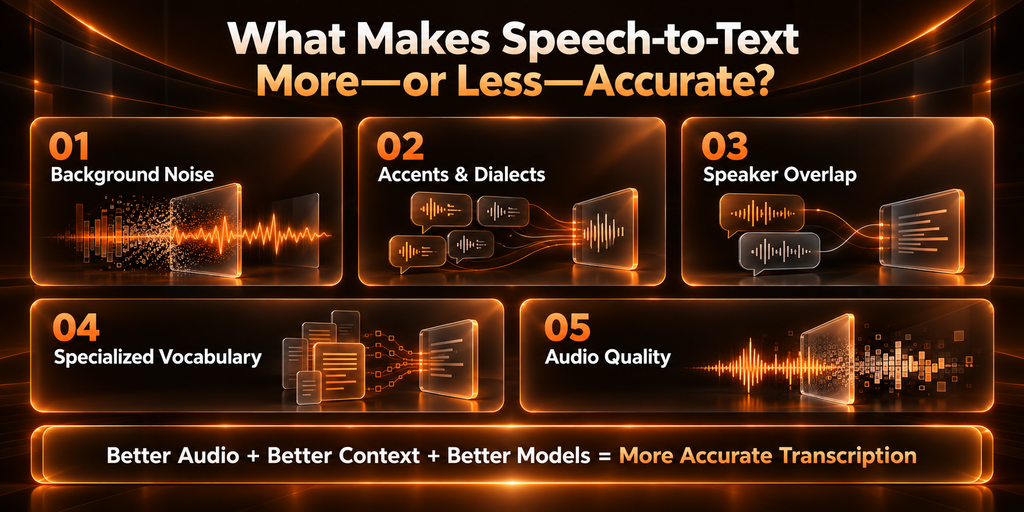
The primary speech-to-text accuracy factors should be known for any provider being considered, as marketing claims are often not aligned with the actual accuracy that the provider achieves with real people, real situations, and real queries they are able to handle.
Key Variables That Influence Accuracy
- Word error rates can double or be higher with background noise and echoes and with low-quality microphones.
- Accent and Dialect: Poor performance with accents or non-native (L2) and code-switched accents may be due to models trained with a limited set of accents.
- Speaker overlap: If two or more persons speak simultaneously, even the more advanced models are challenged to handle this today, although this is a common situation in meetings and contact center environments.
- Specific vocabulary training is needed to transcribe words in technical jargon, brand names, and industry-specific language.
- Low bitrate or compressed audio will lose the details required by the models.
Speech-to-Text Accuracy Factors Worth Prioritizing
Generally, the speech-to-text accuracy factors that have the greatest impact are Custom Vocabulary Support and Speaker Diarization. Companies that can tailor models with these factors can achieve significant impact, particularly in verticals like healthcare, legal, and financial or other niche verticals where inaccuracies may have real-world consequences from one slip of the tongue.
How Does Real-Time Transcription Technology Work?
Real-time transcription technology is used for live captions, voice AI agents, and instant meeting notes, very different from speech-to-text technology that is only used for post-processing. Unlike batch processing, real-time systems transcribe the sound in short segments as it arrives at the system instead of having to upload the entire audio file and wait for it to be transcribed.
Real-Time vs Batch Processing
This will demand a completely new architecture compared to the offline transcription tools. Streaming models need to be fast and accurate and frequently will create a preliminary output transcript followed by a more refined version when additional surrounding text becomes available a little later.
Latency Benchmarks Worth Knowing
For live captioning and voice interfaces, generally a latency of 300 milliseconds is acceptable; however, contact centers using real-time transcription technology may be willing to accept a slightly higher latency in return for improved accuracy for complex conversations.
What Are the Best Speech-to-Text APIs Available Today?
Choosing the best speech-to-text APIs varies significantly based on your specific needs, budget, target languages, and level of control over the API’s model.
What to Look For in an API
- Precision in your target languages, accents, and industry terms.
- Support of real-time streaming, instead of only batch transcription workflows.
- Custom vocabulary, speaker diarization, and punctuation formatting features.
- Cost model, as there are significant differences between per-minute and subscription plans
- Healthcare, government, finance, and other industries that are regulated will need compliance certificates.
Finding the Best Speech-to-Text APIs for Your Stack
Common speech-to-text services available in the market include cloud-based speech-to-text solutions from the hyperscalers as well as specialized services that concentrate only on transcription precision and developer experience. Rather than just taking published benchmarks for granted, developers should experiment with some of the options available and test them out with their own set of audio samples and domain, because things can vary widely in the real world.
Speech Recognition vs Natural Language Processing: What Is the Difference?
Another common confusion is speech recognition vs natural language processing. It’s bigger than it sounds, and it’s important to differentiate. Speech recognition is a process of converting audio into text, which does not understand meaning. NLP (Natural Language Processing) is a technology that can read it and extract intent, sentiment, named entities, and context.
What Speech Recognition Handles Alone
All speech-to-text tools are based on speech recognition technology, which transforms speech into text, or transcribes human speech-to-text. It has no idea of the meaning of the words, just what was spoken.
What NLP Adds on Top of Transcription
Most modern transcription products are not just a transcription of speech as a page of text, but also integrate NLP for added business value. A transcript provides you with what was said – NLP provides you with what it meant, who was meant, and what is supposed to happen next. The two layers combine to make up the current backbone of industries, including voice assistants, meeting summarization tools, and conversational analytics platforms.
How Do Speech-to-Text Software Options Compare?
Any speech-to-text software comparison should be more than just an accuracy rate comparison; it should consider everything from usability to cost and long-term integration of the software with your workflow.
What to Evaluate When Comparing Tools
- Deployment model: Cloud-based, on-premises, or hybrid, depending on your data privacy requirements
- Language and accent coverage: Some tools support dozens of languages; others focus narrowly on English
- Integration options: APIs, SDKs, and plugins for existing communication or CRM platforms
- Turnaround time: Real-time versus asynchronous processing, depending on the use case
- Security and compliance: HIPAA, GDPR, or SOC 2 requirements depending on your industry and geography
Choosing the Right Fit
When it comes to speech-to-text software comparison, there is no clear winner, but the fit is the most crucial. Generally, the right one will be the software that best matches your accuracy requirements, budget, languages you are able to assist with, and the degree of integration the software needs to work into your current communication and CRM infrastructure.
Why Does Speech-to-Text Matter for Businesses Today?
Whereas once speech-to-text was a nice-to-have feature added on to a product, it’s now an essential one that’s become critical infrastructure. Teams can share meetings for search, log sales calls for coaching, and share video and audio content with people who are deaf or hard of hearing.
Everyday Business Use Cases
For geographically dispersed teams with differing time zones, a quality transcript may be more valuable than the call itself, as no one is going to take an hour to watch the call again for a single point of information. That recording becomes searchable within seconds with the technology.
Compliance and Documentation Value
This feature also provides a paper trail for industries that have compliance requirements. With the rise of technology, financial advisors, healthcare workers, and legal teams are increasingly using accurate transcripts to keep records of conversations, comply with regulations, and minimize misunderstandings regarding the content of those conversations. With accuracy continually improving and costs decreasing, this function is moving from a specialized feature of a handful of industries to a standard feature of communication tools.
Where Is Speech-to-Text Headed Next?
The technology is still evolving rapidly, and multilingual models, on-device processing, and managing multiple speakers are among the hottest areas of development today. With models becoming more efficient and cost-effective, facilities that have traditionally had to hire transcriptionists are likely to adopt the technology, and the integration of transcription services and generative AI tools that can automatically summarize, translate, and take action on spoken content will improve.
Conclusion
Beyond being a dictation-only tool, speech-to-text is a key technology driving the creation of meeting transcripts, live captioning, voice assistants, and customer service analytics. Knowing the ins and outs of speech recognition, it’s easier to select the best speech-to-text solution for your team and industry, and to know what accuracy factors are at play and what the difference between ASR and a completed transcript is. The convergence of real-time transcription technology and natural language processing will continue to drive further industry and use case adoption of speech-to-text, making it an everyday source of information for teams that can be searched and acted upon.
Frequently Asked Questions
What is speech-to-text used for?
It’s employed to transcribe meetings, operate voice assistants, caption videos, take notes while talking, and analyze the conversation of customers in call centers on a large scale.
Is speech-to-text the same as voice recognition?
Not exactly. It turns speech into text, and voice recognition determines the voice from an individual’s voice rather than by its content.
How accurate is speech-to-text technology today?
Leading speech-to-text systems today report a mid-to-high 80s rate of accuracy and higher under ideal conditions, according to industry benchmarks, which are based on accuracy under conditions of clear speech and audio.
Can speech-to-text work in real time?
Yes, real-time transcription technology is designed to transcribe audio data in real time, enabling live captions, immediate meeting notes, and even voice assistants with minimal lag time.