What is barge in? Barge-in is voice AI functionality that allows a caller to interrupt an automated agent during their statement, and the automated agent will stop his/her voice, listen to the caller, and then respond. It’s a combination of voice activity detection, echo cancellation, and streaming speech recognition, all of which operate in milliseconds. When implemented properly, it has the effect of creating a human-like conversation with IVR menus and AI voice agents. If it’s not done right, then it cuts people off or speaks over them during the call. This guide will discuss the operation, failure mechanisms, and design of barge-in. You’ll come across latency, echo, and turn-taking problems as you go that determine whether or not callers feel heard.
What Is Barge In, and Why Does It Matter?
Imagine you call your bank and you get a lengthy menu. Since you know you will need it, you say halfway through the prompt. The system shuts down, listens to you, and continues. The time has arrived to barge-in. Let’s get to the technical part of the question: What is barge in? This is the skill of a voice system to recognize when a caller begins to talk while the agent is still talking, to stop the playback immediately and listen to what the caller is saying. Otherwise, it won’t listen until the prompt is terminated.
Barge-In Versus Call Barging
The two get mixed up. “Call barging” in contact centers is a supervisor joining a live call to listen in or step in. Same words, unrelated feature. When people ask what is barge in for AI agents, they mean the caller cutting in on an automated voice.
The Business Case for Letting Callers Interrupt
People are remarkably quick at this. A study across ten languages found the median gap between a question ending and the answer starting was only about 100 milliseconds. Callers carry that rhythm onto every phone call, so a bot that talks over them or makes them wait feels off. The more calls a bot handles, the more its manners matter.
Real people cut in all the time. They fix a wrong detail, skip something they’ve heard, or answer before the question ends. A bot that can’t be interrupted feels scripted, and it can lose information when a caller reads out an account number over the agent’s voice. That’s where what is barge in turns from a definition into a practical question. Solid barge-in gives you:
- Shorter calls, because people skip prompts they already understand
- A stronger sense that the system is genuinely listening
So what is barge in really worth? Mostly, it’s trust.
How Does Barge-In Work in IVR?
Classic IVR platforms have supported barge-in for years. While a prompt plays, the platform keeps an input channel open, and if it picks up a keypress or speech, it cuts the audio and takes the input. So how does barge-in work in IVR day-to-day? Through one of two input types, and each has its own trade-offs.
DTMF Barge-In
Ask a veteran IVR designer what is barge in, and they’ll often start with DTMF. The caller presses a key during the prompt, and the system moves on. It’s simple, reliable, and cheap to run.
Speech Barge-In
Here the caller talks over the prompt. It feels more natural, but recognition has to run during playback, which is where trouble starts. Noise and echo can trigger false stops. If you’re comparing what barge-in for speech versus keys is, speech is the harder one to get right.
When to Disable Barge-In
Many designers switch it off for legal disclosures or allow it only for specific keywords. That’s a sensible safeguard, since interrupting a conversation already in flight is a well-known frustration. The catch is that every rule makes the experience a little less fluid, so test with real callers first. And how does barge-in work in IVR once it’s switched off? It doesn’t, and that’s by design.
How Does Barge-In Detection in Voice AI Work?
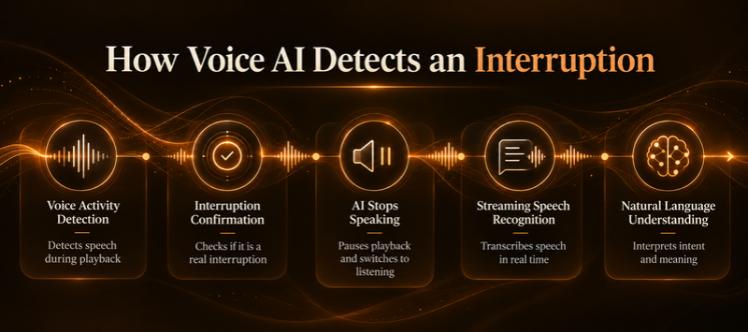
Modern AI agents go well beyond IVR menus. Understanding what is barge in detection starts with the pipeline, because barge-in detection in voice AI is a chain of small decisions made in fractions of a second.
Voice Activity Detection
Voice activity detection (VAD) is a lightweight classifier that labels short slices of audio as speech or non-speech, even while the agent is talking. The catch: VAD can’t tell a cough from a real interruption. So what is barge in detection really checking first? Whether a sound is a person at all. Good echo cancellation and barge-in tuning keep VAD honest.
Endpointing and Streaming Recognition
The second layer, endpointing, is the layer that determines whether or not the speech deserves a stop. It’s that layer that sets barge-in detection in voice AI apart from a volume meter. Text-to-speech stops, and the pipeline switches to listening mode once it has been confirmed. What is the meaning of barge in confirmation? A quick examination of the importance of the sound. Streaming recognition, then, will transcribe the audio as it is received, rather than once the caller is done, reducing the delay between audio and the written response.
Natural Language Understanding for Interruptions
Natural language understanding decides what an interruption actually means. “Mm-hmm” is encouragement. “Wait, that’s the wrong date” is a correction. “Stop” is a command. A system that treats all three the same will either freeze constantly or ignore people who truly need to be heard. Good natural language understanding is how teams cut false triggers without making the agent deaf. Those intent signals also feed turn-taking in conversational AI, and they’re central to what is barge in handling versus plain background chatter.
What Is the Difference Between Full-Duplex vs Half-Duplex Voice AI?
The full-duplex vs half-duplex voice AI question comes down to one thing: can the system listen while it speaks? The answer decides whether barge-in is even possible. That’s why anyone asking what is barge in should first ask whether the pipeline is full-duplex.
Half-Duplex Systems
A half-duplex system stops listening the moment it starts talking. It must finish its turn before it hears you, so barge-in isn’t possible. And what is barge in worth on a half-duplex line? Nothing, because it can’t happen.
Full-Duplex Systems
Here the microphone stays live during playback, so the system can hear a caller cutting in and react. Newer speech-to-speech models go further by listening and speaking at the same time. The trade off is a new headache: the system can end up hearing itself, which is why echo cancellation and barge-in always come up together.
Why Do Echo Cancellation and Barge-In Go Together?
Speaker audio leaks back into the microphone, especially on speakerphones, in cars, and with cheap headsets. In the full-duplex vs half-duplex voice AI debate, this is the price full-duplex pays. Left alone, it breaks barge-in, so anyone studying what is barge in should study echo too.
How Self-Interruption Happens
Without correction, VAD hears the agent’s own voice, decides the caller interrupted, and the agent cuts itself off mid-sentence. And what is barge in worth if the bot keeps interrupting itself?
How Echo Cancellation Fixes It
Echo cancellation and barge-in are two halves of one fix. Acoustic echo cancellation subtracts the agent’s outbound audio from the incoming signal, so detection reacts only to the caller. In practice:
- Test on speakerphone, Bluetooth, and in-car audio, not just clean headsets
- Expect higher false-trigger rates in noisy environments
What Are the Barge-In Latency Challenges?
Speed is where barge-in lives or dies. What is barge in without speed? A feature that arrives too late to help. Barge-in latency challenges usually come from a handful of small delays that add up.
Where the Delay Comes From
Delays stack up quietly across the pipeline:
- Detection time before VAD fires
- Confirmation time before the system trusts it
- Audio already queued in playback buffers, which keeps talking after you say stop
- Recognition and language model time before a reply starts
Human turn gaps are short, often just a few hundred milliseconds, so even a one-second lag feels like the agent is talking over you. If the playback queue isn’t flushed on interruption, the caller hears a few more words after they’ve started speaking.
Balancing Speed Against False Triggers
Thresholds add a tradeoff. A shorter endpointing window reacts faster but fires more often on noise. A longer one is safer but slower. Newer approaches, such as semantic VAD that looks at what’s being said and not just the sound, are narrowing that gap, which shows barge-in detection in voice AI is still improving. In the end, what is barge in tuning if not a negotiation between speed and accuracy?
Strong voice AI interruption handling also depends on trimming this lag, one of the barge-in latency challenges teams hit most. A symptom-intake line should lean toward catching every interruption, while a line reading a required disclaimer can afford a steadier setting.
How Does Turn-Taking in Conversational AI Shape Interruptions?
People negotiate turns without thinking. We read pauses, pitch, and filler words to know when it’s safe to jump in. Voice agents lack that instinct, so turn-taking in conversational AI has to be approximated with signals and rules. Here, what is barge in is only one piece of the puzzle.
Backchannels Versus Real Interruptions
Barge-in covers one slice: the caller-initiated case. Backchannels are different. Short sounds like “yeah” or “mhm” signal listening, not a request to take the floor. Knowing what is barge in, and what it isn’t, keeps a system from sounding jumpy every time someone says “mhm.”
Agent-Initiated Interruptions and over talk
Agent-initiated interruptions, where the agent jumps in to correct something, follow different rules. Over-talk is a whole-call measure of simultaneous speech, and it includes the agent starting too early. Good turn-taking in conversational AI treats these as different signals, and mixing them up leads to bad tuning. None of this changes what is barge in at its core: the caller interrupting the agent.
What Does Strong Voice AI Interruption Handling Look Like?
Voice AI interruption handling goes beyond stopping the audio. Knowing what is barge in is step one; handling it well is step two. What happens after the stop decides whether the call recovers.
Recovering After the Stop
Once you know what is barge in, the next question is what to do with it:
- Track what the caller actually heard. If the agent was cut off halfway, the language model should treat only the spoken portion as delivered.
- Keep the interrupted thread alive. Sometimes the caller wants to answer and then return to the earlier topic.
- Set rules by prompt type. Greetings and menus can stay wide open. Disclosures might need protection.
Tuning in Production
So what is barge in tuning in practice? It’s the ongoing job of watching live calls for false triggers and missed interruptions, then adjusting thresholds to match your actual callers. Barge-in latency challenges show up first in live calls, so test with real call audio, since synthetic clips rarely capture accents or how people really interrupt.
What Is the Best Way of Designing Natural Voice Interruptions?
Designing natural voice interruptions is half engineering, half conversation design. If you’re mapping out what is barge in for your own call flows, a few habits and examples help.
Prompt Design Habits
- Keep prompts short. The less the agent says, the less there is to interrupt.
- Put key information first. Callers who barge in usually know the rest.
- Recover gracefully. A quick “sorry, go ahead” beats silence or a repeated sentence.
Real-Call Examples
So what is barge in like for real people? Designing natural voice interruptions gets easier with real examples:
- Banking: a caller says “balance” before the menu finishes and skips straight to the answer.
- Healthcare: a patient interrupts a scheduling prompt to say the appointment is for a child.
In each one, what is barge in really doing? Letting the system that listens win the caller’s trust.
Conclusion
Barge-in is a seemingly minor aspect, but it’s one that’s noticed by callers within seconds. It relies on the correct full-duplex vs. half-duplex voice-AI selection, clean echo cancellation, prompt detection, and sufficient natural language abilities to distinguish a true interruption from noise. Be right on those, and the discussion continues. If it’s wrong, the agent either interrupts itself or doesn’t listen to the caller. If you are looking for what is barge in worth to your caller, then it is a sign that someone, or something, is listening. With robust voice AI interruption control and crafting voice interruptions naturally, that becomes a better call. Begin with real call audio, monitor false triggers and un-notified calls, and continue tuning with changing uses and callers.
Frequently Asked Questions
What is barge in?
Barge-in is a feature in the voice system that allows a caller to interrupt while a voice system is in operation. The system plays out the content, listens to the new input, and responds to it instead of the caller waiting for the prompt.
How does barge-in work in IVR systems?
The majority of IVR systems allow for barge-in using keypresses or speech. Designers may turn it on or off for menus or turn it off for legal disclosures, or limit it to specific words to prevent unwanted interruptions.
Why does barge-in matter in voice AI?
It allows for natural conversation. Callers jump over the prompt they know, correct errors in a hurry, and don’t repeat themselves again, thereby saving time and frustrating automated phone systems and agents.
How do you reduce false barge-in triggers?
Utilize echo cancellation, adjust sensitivity settings, set minimum speech time, and differentiate between back channels (such as ‘mhm’) and true interruptions. Test using real call audio in quiet and noisy environments.